
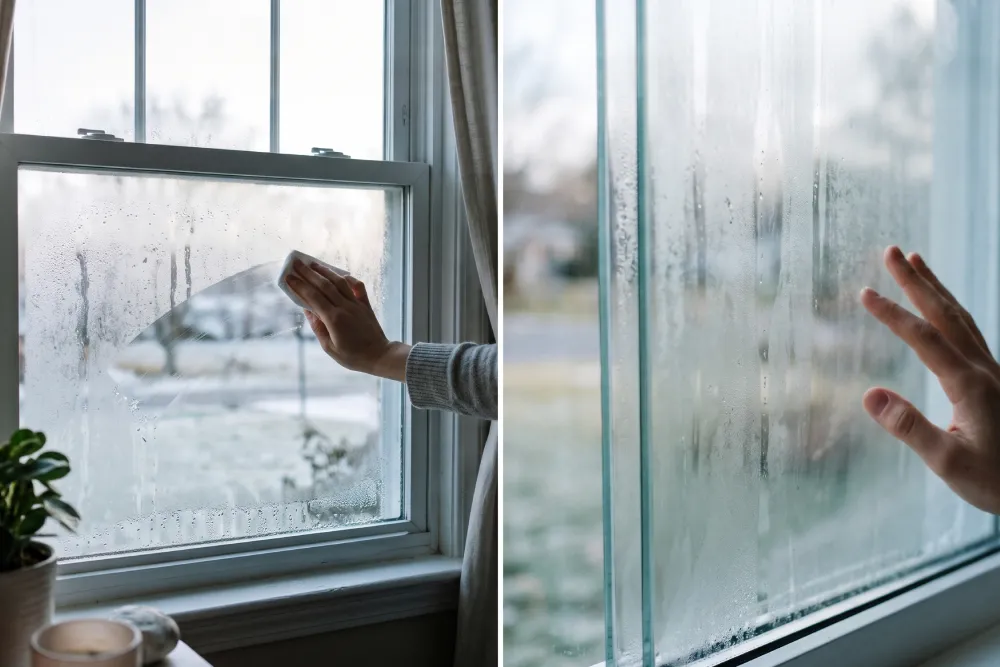
When comparing window condensation inside vs between panes, the most useful first step is to locate the moisture. Water on the room-facing surface, moisture outside, and fog trapped within insulated glass are different observations. They should not automatically lead to the same explanation or repair.
Interior condensation often involves indoor moisture meeting cooler glass. Persistent moisture within a sealed glass unit can indicate a problem with that unit. Exterior condensation can occur under certain weather conditions and does not, by itself, establish that a window needs replacement.
If you are noticing wet windows in a Nicholasville or Lexington home as the weather changes, document the condition before deciding what to buy. A clear description helps a window professional assess the glass, frame, installation, and surrounding conditions more accurately.
First, Identify Which Surface Is Wet
Start from a safe position inside the home. Look at whether the moisture appears on the surface facing the room or seems trapped beyond it.
If the accessible room-facing surface is wet, that is useful information. Do not lean outside, climb onto furniture, or attempt exterior access to investigate an upper-story window. A professional can assess areas you cannot safely reach.
Record whether the condition affects one window or several, and whether it appears in bedrooms, bathrooms, kitchens, or another area. Note the time and recent activities, such as cooking or showering.
A photograph taken before the moisture clears can help. Include the whole window and a closer view showing where the moisture appears. The goal is to preserve observations, not to diagnose a seal or installation problem from one picture.
Understand Interior Window Condensation
Interior window condensation occurs when moisture in room air condenses on a sufficiently cool surface. The visible water is a clue about conditions at that surface, but it does not identify every contributing cause.
Andersen’s interior-glass condensation guidance explains that indoor moisture can form on glass and that this observation alone does not indicate glass failure.
Daily activities can introduce moisture, while airflow, indoor temperature, window characteristics, and outdoor conditions affect what happens at the glass. That is why replacing a window without understanding the pattern may not address the whole problem.
Avoid reducing the issue to one universal indoor humidity number. Conditions vary by building and weather. A qualified assessment can consider the home and the window together rather than treating every damp pane as the same case.
Notice Patterns Around Everyday Activities
Ask when the moisture appears. Does it form after a hot shower, during cooking, overnight in a bedroom, or throughout the day?
Check whether ventilation equipment is functioning and being used as intended. A bathroom fan that sounds active but is not removing air effectively may need attention from the appropriate professional. Do not assume the presence of a fan proves that ventilation is adequate.
Observe window coverings as well. A tightly enclosed area behind curtains or shades may have different air movement from the rest of the room. Record the condition without assuming the covering is the sole cause.
These observations help distinguish a recurring indoor moisture pattern from a problem isolated to a particular glass unit. They also make an inspection more productive than a general report that “all the windows are bad.”

Understand Moisture Between Window Panes
A double- or triple-pane insulated glass unit contains a space between its glass layers. Moisture visibly trapped within that assembly is different from water on an accessible surface.
Persistent internal fogging can be associated with a loss of the unit’s intended seal. However, a professional should confirm the location and assess the window before recommending a remedy.
Do not assume that all cloudy glass is condensation. Surface deposits, cleaning residue, films, and other conditions can affect appearance. An inspection can help distinguish these possibilities.
Also separate the insulated glass unit from the complete window assembly. Depending on the product, condition, availability, and warranty, the relevant repair or replacement discussion may concern the glass unit, a sash, or the full window. Those options are not interchangeable, and they should not be promised without evaluating the specific product.
Exterior Condensation Needs a Different Conversation
Moisture can form on the outside of window glass when surface and weather conditions allow it. It may be most noticeable at a particular time of day and clear as conditions change.
Andersen’s exterior condensation explanation describes weather-related factors that can contribute. The presence of outside moisture alone does not establish a defect.
If exterior condensation is your main concern, tell the inspector when it appears and whether it disappears. Note differences between shaded and exposed windows if you can observe them safely.
Do not confuse this condition with water entering around a frame or through a building opening. Rain-related leakage, damaged trim, or recurring staining deserves its own assessment even if condensation also occurs at other times.
Look at the Frame and Surrounding Materials
The glass is only part of the observation. Check accessible sills, trim, walls, and nearby finishes for recurring water, staining, deterioration, or changes in appearance.
Describe what you see without assuming the source. Water on a sill may relate to condensation, a leak, or another issue. The timing matters: moisture after rain suggests a different investigation from water appearing on cold mornings without precipitation.
If materials are staying wet or damage is developing, arrange an appropriate assessment rather than repeatedly wiping the surface and considering the issue solved.
Avoid opening wall cavities, removing glass, or applying a repair product based on a guess. Those actions can complicate the diagnosis and may affect a manufacturer’s warranty or the condition of surrounding materials.
Build a Simple Observation Record
A short log can make window seal assessment more useful. Record the date, approximate time, affected window, apparent moisture location, and recent weather or indoor activity.
If you have an appropriate indoor temperature and humidity monitor, record its reading and location. A room reading is context, not a direct measurement of the temperature at the glass or proof of a particular cause.
Take photographs under similar conditions when possible. Repeated images can show whether the pattern changes with weather, ventilation use, or the location within the house.
You do not need weeks of documentation before seeking help, especially if materials are being damaged. Even a few accurate observations can give the inspector a stronger starting point than a diagnosis borrowed from a photograph of someone else’s window.
Ask What the Inspection Will Evaluate
Before scheduling, ask which parts of the window and surrounding opening the assessment covers. Glass condition, frame operation, visible installation details, and signs of water entry may all be relevant.
Explain whether you are seeking a replacement estimate, help identifying the condition, or both. A company should understand the question you need answered before recommending a product.
Ask how the findings will distinguish interior moisture, sealed-unit fogging, and possible leakage. If another trade or specialist is needed, the next step should be clear.
For an older window, gather any available manufacturer label, installation record, or warranty information. Do not remove parts to find a label. Accessible documentation may help identify whether replacement components are available and which product-specific conditions need consideration.
Review TSmith’s exterior improvement services when framing the inspection request, particularly if moisture is also visible around surrounding exterior components.

Compare Remedies Based on the Confirmed Problem
A remedy should respond to the finding. Indoor moisture management, repair of water entry, replacement of a failed glass component, and full-window replacement solve different problems.
When replacement is proposed, ask what condition it addresses and what it will not necessarily change. A new window does not remove every source of indoor moisture or correct an unrelated roof or wall leak.
Compare proposals on scope as well as product features. Determine which components are included, how surrounding finishes are handled, and what inspection or follow-up is part of the work.
T. Smith Siding & Windows provides replacement-window services in Central Kentucky. Its Hartland window-replacement page identifies between-pane condensation among the conditions homeowners may notice. That observation is a reason to assess the actual window, not a substitute for confirming which surface is affected.
Avoid Quick Fixes That Hide the Question
An online cleaning trick may change what you can see without resolving why the moisture formed. Likewise, adding sealant to an accessible joint does not automatically repair an insulated glass unit.
Do not drill glass, dismantle a sash, or use an unapproved product in an attempt to clear internal fog. Ask about product-specific repair options and warranty implications first.
Be cautious with a diagnosis based solely on the season. Cold weather can make a condition more visible, but “it only happens in winter” does not identify one cause.
The practical goal is a useful explanation followed by a remedy with a defined scope. That approach helps you avoid paying for a solution that addresses the appearance while leaving the underlying issue unresolved.
Use the Moisture Location to Guide the Next Step
The difference between window condensation inside vs between panes is not just terminology. It changes the questions an inspection needs to answer.
Start with safe observations, note the pattern, and preserve photographs or records that show the condition. Then discuss the findings and available options with a professional who can evaluate the specific window.
For Nicholasville and Lexington homeowners, that process provides a more informed basis for deciding whether the next step involves moisture management, further investigation, a component option, or replacement-window planning.
Frequently Asked Questions
Does condensation on the inside mean my window seal failed?
Not by itself. Moisture on the room-facing surface can form when indoor air meets cooler glass. That differs from moisture trapped within an insulated glass unit. Record where the moisture appears and have recurring conditions assessed, particularly if surrounding materials are staying wet or becoming damaged.
Can between-pane fog be wiped away?
Moisture inside the sealed space cannot be wiped from an accessible room-facing surface. First confirm that the cloudiness is actually within the unit rather than residue or another surface condition. A professional can then discuss the product-specific options and whether a component or larger replacement is appropriate.
Why do only some windows develop moisture?
Exposure, room activities, airflow, coverings, and differences in the windows can affect the pattern. One affected window does not automatically identify the cause. Compare when and where the condition appears, and share those observations during the assessment instead of assuming every window needs the same remedy.
Should outside window condensation worry me?
Outside condensation can occur under certain weather conditions and does not alone establish a defect. Note its timing and whether it clears. If you also see rain-related leakage, damaged trim, or wet surrounding materials, describe those separately because they may require a different investigation.
Should I replace the whole window or only the glass?
That depends on the product, frame and sash condition, component availability, warranty, and the confirmed problem. Do not assume either option is always possible or preferable. Ask for an explanation of the recommended scope and how it addresses the condition observed in your particular window.
Discuss Your Window Concerns With T. Smith
If recurring moisture or foggy glass is raising questions about your Central Kentucky windows, contact T. Smith Siding & Windows. Share photographs and the location of the moisture so the conversation can focus on the condition you are actually seeing.
